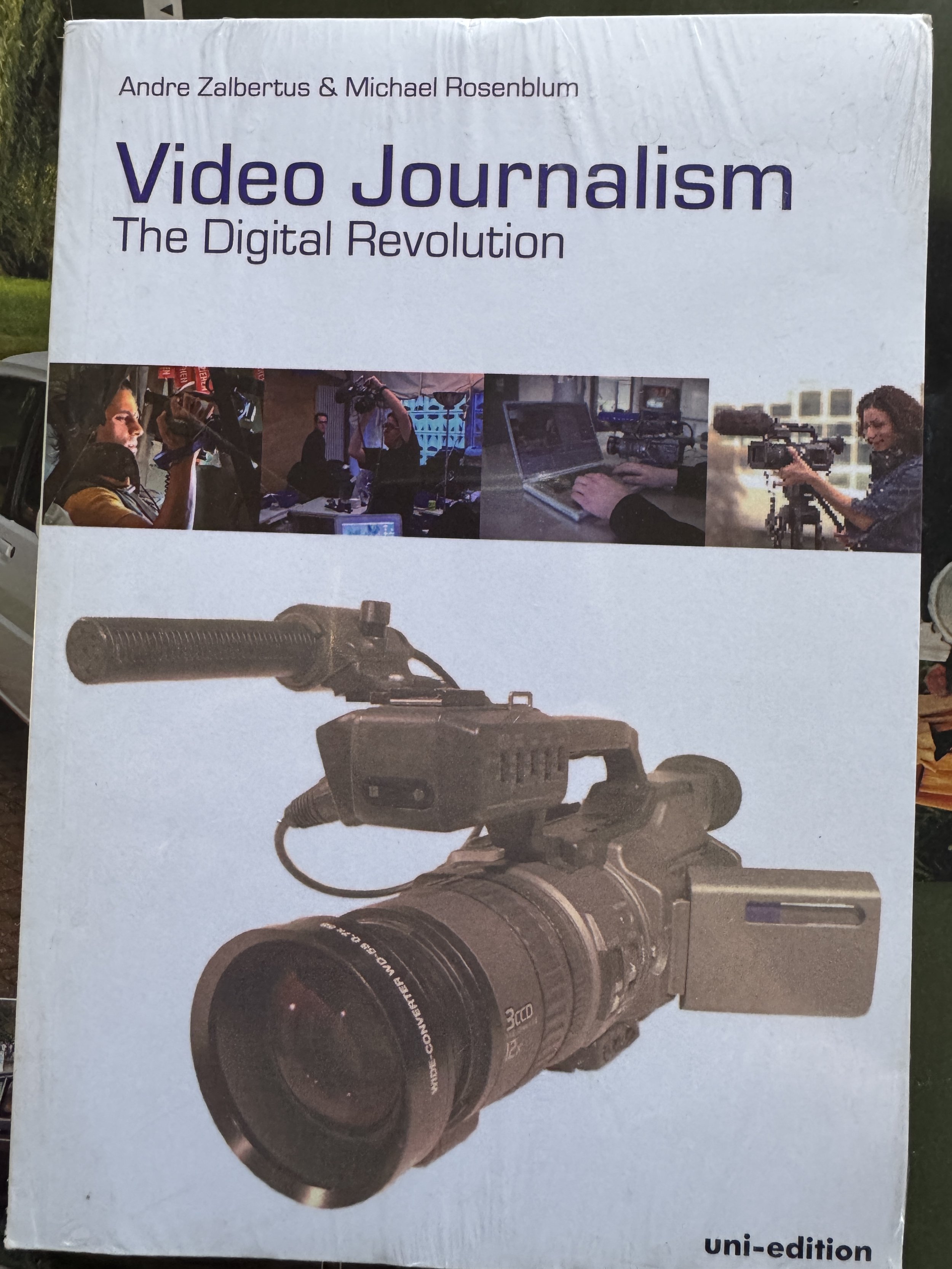
VIDEOJOURNALISM
The Digital Revolution
Andre Zalbertus & Michael Rosenblum
Published by Uni-Edition, 2004
What if one person, armed with a small video camera and a laptop, could do the work of an entire television news crew?
Today, the idea seems obvious. In the early 2000s, it was revolutionary.
In Video Journalism: The Digital Revolution, television pioneers Andre Zalbertus and Michael Rosenblum make the case for a radical transformation of television news production—one that would challenge decades of established practice, expensive equipment, large production crews, and the traditional division between reporters, camera operators, and editors.
At the heart of their argument was a simple but powerful idea: the Video Journalist, or VJ. A single individual who could report, shoot, edit, and produce an entire television story.
Drawing on their pioneering experiments in Germany, including the creation of a new generation of video journalists, Zalbertus and Rosenblum describe both the philosophy and the practical experience behind a movement that was challenging the foundations of the broadcasting industry.
The book explores the possibilities of inexpensive digital cameras, computer-based editing, and a radically different approach to visual storytelling. It also chronicles the resistance that inevitably accompanies technological change.
First published in 2004, Video Journalism: The Digital Revolution captures a remarkable moment in media history, when ideas that are commonplace today were considered threatening, impractical, and even heretical.
More than two decades later, when virtually anyone with a smartphone can shoot, edit, and distribute video to a worldwide audience, the revolution the authors advocated has become part of everyday life.
What was once a radical prediction has become reality.
Video Journalism: The Digital Revolution is both a practical exploration of a new form of journalism and a fascinating historical document of the early days of the digital media revolution.